How effective is your team? A ten-point team wheel.
This wheel uses ten conditions for team effectiveness, drawn from published research on teams and from our consultants’ work with them. Score your team, see the shape it makes, then pick three to act on.
On this page
Score each condition from 1 to 7 and draw your wheel, then pick three to act on and print the plan. Nothing is stored.
Free download: The team wheel ↓Where the ten conditions come from
Two strands of research sit behind the wheel. The late J. Richard Hackman spent decades studying teams, from airline cockpits to orchestras, and argued that leaders do more for a team by getting its basic conditions right than by stepping into its day-to-day work. His conditions include being a real team with a clear boundary, a compelling direction, a structure that enables the work, a supportive organisational context and good coaching; later work with Ruth Wageman and colleagues on senior leadership teams added having the right people.
Google’s Project Aristotle, a study of its own teams published in 2015, found that how a team worked together mattered more than who was on it, and named five dynamics: psychological safety, dependability, structure and clarity, meaning, and impact. Psychological safety as a team property was first set out by Amy Edmondson in 1999.
We have combined and reworded these into ten conditions a manager can recognise and score. The descriptions are ours, and the wheel is a prompt for discussion, not a validated measure.
The ten conditions
What each condition looks like in a team that has it, why it matters, and the research it draws on. The numbers match the tool.
A real team
Everyone knows who is on the team and who is not. Membership stays fairly stable, and the work cannot be done without people relying on one another.
Why it matters. If people could succeed on their own, much of the effort spent on teamwork is wasted. A clear boundary also tells people whose problem a problem is.
Draws on: Hackman
Compelling direction
The team can say in a sentence or two what it is for. The aim is clear enough to steer by, stretching enough to need everyone, and important to the people it serves.
Why it matters. A purpose people care about is what they fall back on when priorities clash and the plan runs out.
Draws on: Hackman
The right people
Between them, members have the knowledge, skills and range of views the task needs, and the team is no larger than it has to be.
Why it matters. Missing skills are expensive to discover late, and every extra member adds to the effort of keeping everyone in step.
Draws on: Wageman et al.
Clear roles and plans
Each person knows what is expected of them, how their work connects to everyone else’s, and what the team is aiming to deliver by when.
Why it matters. Clarity removes duplicated effort, and the quiet gaps where everyone assumed someone else was doing it.
Draws on: Project Aristotle; Hackman
Agreed ways of working
The team has settled, out loud, how it makes decisions, runs its meetings, shares information and handles disagreement.
Why it matters. Unspoken rules get applied unevenly. Agreed ones can be checked, and changed when they stop working.
Draws on: Hackman
Safe to speak up
People raise concerns, admit mistakes, ask basic questions and offer half-formed ideas without worrying that it will count against them.
Why it matters. Problems surface while they are still small, and the team learns from what went wrong instead of hiding it.
Draws on: Edmondson; Project Aristotle
Dependability
When someone says they will do something, it gets done, to the standard agreed and when promised – or they say early that it will not.
Why it matters. Kept promises are what let colleagues trust each other without checking up on each other or working round each other.
Draws on: Project Aristotle
Work that matters
Members find the work worthwhile and can see the difference it makes, to customers, colleagues or the organisation.
Why it matters. People who see the point of their work put in the extra thought that no checklist can ask for.
Draws on: Project Aristotle
Backing from the organisation
The team gets the information, time, tools and resources it needs, and good team results are noticed and recognised, not only individual ones.
Why it matters. A well-run team can still stall if the organisation around it starves it of what it needs or rewards only individual effort.
Draws on: Hackman
Review and coaching
The team regularly stops to look at how it is working, not only at what it is producing, and someone helps it do that well.
Why it matters. Teams that never review tend to repeat their mistakes. In our experience, help lands best at natural pauses – the start, the midpoint, the end – rather than in the middle of a crisis.
Draws on: Hackman
Reading the wheel
Look at the shape before the average
A team that scores 5 everywhere and a team that scores 7 on half the wheel and 3 on the rest have the same average and very different problems.
Notice which half is low
The first three conditions, and backing from the organisation, are largely set before the team meets: who is on it, what it is for and what it gets. If those are low, the fix usually sits with whoever set the team up, not with its members. Low scores on safety, dependability and ways of working are more often something the team can work on itself.
Compare wheels, then talk
Ask each member to score the wheel alone, then put the wheels side by side. We suggest starting with the condition where your scores are furthest apart: people who see the same team very differently usually have the most useful conversation to have. Where everyone scores low, you have agreement on the problem, which is a good place to begin.
Picking three to act on
Pick three, not ten. A low score on something your team rarely needs can wait; a middling score on something it depends on every week cannot. For each, write one thing you will do, who leads it and by when, and how you will know it has worked. If you cannot say what you would see or hear differently, the action is too vague. Score the wheel again after three months.
If the first condition is your lowest, you may be a working group rather than a team, which can be a perfectly good thing to be. Starting a new team or project has a short test for telling the difference, and Eight team exercises that get people talking honestly has ways to open up the conversation once you have your wheels.
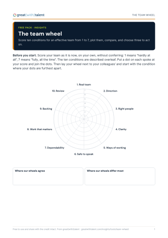
The team wheel
A blank wheel to mark up by hand, the ten conditions with a score column, and a page for your three actions.
Written by great{with}talent from our consultants’ practice. The ten conditions draw on J. Richard Hackman, Leading Teams: Setting the Stage for Great Performances (Harvard Business School Press, 2002); Ruth Wageman, Debra Nunes, James Burruss and J. Richard Hackman, Senior Leadership Teams (Harvard Business School Press, 2008); Google’s Project Aristotle (re:Work, 2015); and Amy Edmondson, “Psychological safety and learning behavior in work teams”, Administrative Science Quarterly (1999). The descriptions are our own. To measure team environment across a whole organisation, alongside leadership, engagement, strategy, structure and process, see WinningFormula.
The clearest thirty minutes in your week.
Send us your last engagement survey and we’ll show you what it’s missing – no charge, no deck, no obligation. Or start with a pilot or a 30-minute conversation.